He enlisted into the 48th Pennsylvania Infantry in December 1861 at St. Clair, Schuylkill, Pennsylvania.
His Descendants Have Made It Possible That We Can Tell His Story


The Crests of Offaly & Pennsylvania
According to the available records several members of The Heaton Family from the Ferbane area in County Offaly arrived in the US in 1840. The year they left Ireland was at the early period of The Great Famine in their homeland and like many other Irish families who chose to emigrate it was, in all likeliness, their last resort. It must also be remembered that at this time leaving for the distant shores of America meant accepting that you would never see extended family, friends and neighbors again. The famine would fracture thousands of families and communities in Ireland and, as a result of circumstances completely beyond their control, a whole generation of Irish people would be scattered throughout the United States of America.
Carey Heaton was only 1 year of age when he left Ferbane in 1840 completely unaware of how such a major historical event as the Irish Famine meant he would grow up in Schuylkill County, Pennsylvania more American than Irish. But other events in his newly adapted country that had been simmering since the start of the 1800’s would also mean, on becoming an adult, once again circumstances beyond his control would alter his life forever. The bitter US Civil would begin in 1861 when Carey Heaton was just 22 years old, the perfect age for a soldier and at a time when many were required.

1860 US Census Image | findmypast.ie – Carey & Bridget Heaton (Trumple)
When Carey Heaton enlisted in the 48th Pennsylvania Infantry in late 1861 he was already a married man. He had wed Bridget Trumple a year earlier and the couple had a young child named John. Carey Heaton was working in the busy local coal mines as were many of the men in that area of Pennsylvania. Many of the workers in the mines around St. Clair, Schuylkill would choose to enlist in the Union Army at the outbreak of the Civil War no doubt seeing a life in the Army as being a better option to life in the harsh coal mines. Ironically that experience of working in the mines would, at a later point in the war, lead those miners who became soldiers in the 48th Pennsylvania Regiment playing a major role in one of the most renowned incidents of the entire conflict.


Miners in Pennsylvania, Coloured Engraving from 1860
Carey Heaton was assigned to Company B and over the next 12 months his 48th Pennsylvania Regiment would mostly be based in the area on New Berne in North Carolina. Between the months of March & July 1862 they would be involved in trying to secure access to the ports and fortifications along the Carolina’s coastline. In early August of 1862 the 48th were transferred to Northern Virginia and over the rest of that year would be involved in notable and violent battles such as 2nd Bull Run in August and Antietam in September of that year. Cary is actually briefly mentioned in the diary of Captain James Wren who was a commanding officer of the 48th at Antietam. The passage recounts Cary and a colleague firing on rebel soldiers along a skirmish line at the battle front.

Thanks to Jen Foley

James Wren
These famous engagements would prove to be difficult ones for the Union Army as General Robert E. Lee and his Confederate Army seemed to constantly out manoeuvre his Union counterparts. By the time they arrived at Fredericksburg, Virginia in the beginning of December of 1862 the 48th Pennsylvania Regiment were no doubt a weary but experienced and battle hardened outfit. The Battle Of Fredericksburg would again be a place where Lee would have the upper hand on his opponents and the eventual defeat of the Union forces there would later lead to a change in the overall command of the Union Army. The pointless tactics employed by the Union Generals would result in almost 13,000 casualties at Fredericksburg. A later account given by a fellow soldier in the same regiment as Carey Heaton gives a vivid description of the confusion and chaos that must have been felt by the men during battle.
“It has been truly said that only those who participated in the contest know how much and how little they heard. We remember how the smoke, the woods, and the inequalities of the ground limited our vision when we had the leisure to look about us, and how every faculty was absorbed in our work; how the deafening noise made it impossible to hear orders; what ghastly sights we saw, as men fell near us, and how peacefully they sank to rest when a bullet reached a vital spot“
Private Joseph Gould – Company F, 48th Pennsylvania Infantry – 13th December 1862 at Fredericksburg
For Carey Heaton it would also prove to be a place he would never forget as he is wounded in the left foot by an exploding shell during those assaults on the heavily fortified Confederate positions overlooking the battlefield. Cary was taken from the field with the help of some of his comrades and records show that he was originally treated at field hospital near Fredericksburg before being transferred to St. Elizabeth’s Hospital in Washington DC. He would remain at St. Elizabeth’s and recuperate over the next 8 Months but the injuries received at Fredericksburg would stay with him for the rest of his days.

Waud, Alfred R. Library of Congress Catalog: https://lccn.loc.gov/2004661366 Image
Battle of Fredericksburg – Wikipedia


Medical Record of Carey Heaton


Thanks to Jen Foley
St. Elizabeths Hospital in the Civil War – National Museum of Civil War Medicine
By September of 1863 Carey Heaton is released back to 48th Pennsylvania Regiment who were by now stationed near Knoxville in Tennessee. Over the rest of that year he is employed as a teamster servicing the supply trains for his regiment. This was another vital component in the Union war effort all throughout the war. Supplying the huge numbers of troops was a 24 hour job and the trains and wagons were vital in keeping the supply of food and clothing reaching the men. Equally as important was the constant supply of ordnance and weaponry to the battle front and the records indicate this was the area that Carey was engaged in while at Knoxville.


Re-Enlisted in January 1864
Thanks to Jen Foley
In December 1863 his agreed period of enlistment in the Union Army is coming to and end but Cary decides to re-enlist for another 3 year term while stationed at Blaine’s Crossroad in Tennessee on the 1st January 1864. He is once again assigned to Company B of the 48th Pennsylvania Regiment. The men from Pennsylvania would remain in camp at Blaine’s Crossroad over the early winter months before moving in March of 1864 to Maryland where they would be re-organized before embarking on what became known as The Overland Campaign of May & June of 1864. During this period they would see action at battles such as The Wilderness, Spotyslvania, Cold Harbor and the early stages of the Siege at Petersburg. Once again during this period the available records suggest that Cary was working on the supply trains connected to his regiment. The 48th would later return to the Petersburg area in June of 1864 and it is here, as mentioned earlier, that their mining skills would lead them to become embroiled in one of the most famous and equally infamous events of the war. A frustrated and innocuous comment by a private soldier in the 48th Pennsylvania regiment would lead to a daring plan being devised to open a breach in the Confederate fortifications around Petersburg in late July 1864.
“We could blow that damn fort out of existence if we could run a mine shaft under it.”
– A private of the 48th Pennsylvania
“Spurred by the offhand suggestion of a former coal miner, on June 25, 1864, Lieutenant Colonel Henry Pleasants put his 48th Pennsylvania to digging. Their objective: to tunnel under the Confederate line and blow up the battery at Elliott’s Salient“
Beginning on June 25, 1864, and continuing for the next month, these Pennsylvania coal miners burrowed a shaft 511 feet into this hillside. Then they packed four tons of powder into the magazines under the Confederate battery. At 3:15 a.m. on July 30, Pleasants lit the fuse and scrambled out of the tunnel”
Digging the Mine wayside marker
Unfortunately the records of Carey Heaton’s service do not state that he was involved in the digging of the tunnel under the Confederate lines but we can be sure he was very much aware of what was happening. The massive explosion detonated on the morning of the 30th of July shook the countryside around Petersburg and as planned a massive opening was created in the line of the Confederates. The 48th were not designated as one of the regiments assigned to charge through the opening and this would prove to a costly mistake on the part of the Union commanders. The soldiers that did charge through the breach ended up at the bottom of the huge crater that had been created and were easily picked of by the defending Confederates who by this time had regained some composure. July 30th 1864 would prove to be a debacle for the Union Army and close to 4,000 men were killed or wounded on that day. It must have been a bitter pill for the mining men of the 48th to swallow as their flawless skills had created a huge opportunity for the Union Army to finally break the impasse at Petersburg only to end up in disaster.

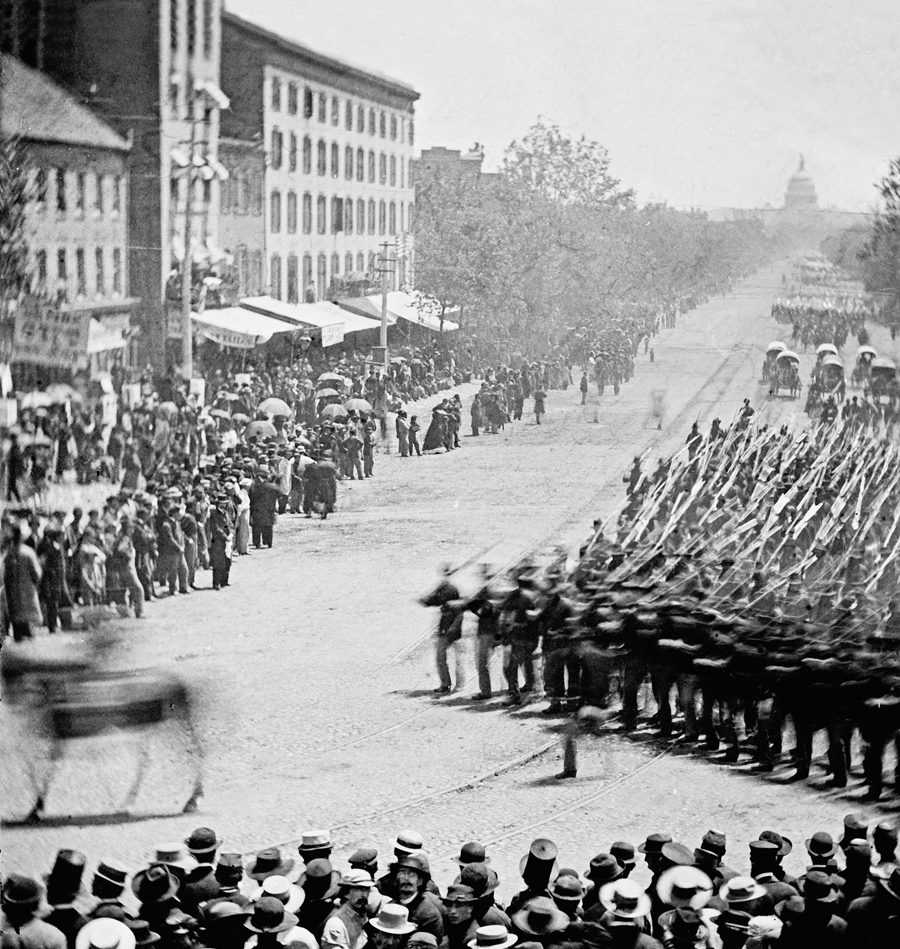
By April of 1865 the Civil War is moving towards its climax and Petersburg would finally fall on the 9th of that month allowing the Union forces including the 48th Pennsylvania to finally occupy the city. A week later Robert E. Lee would surrender his Army of Northern Virginia at Appomattox and this effectively brought the war to a close for the majority of soldiers. On May 23rd of 1865 the 48th Pennsylvania Regiment were present at the Grand Review of the Army that was held in Washington DC and hopefully Carey Heaton was among his comrades as they marched past the dignitaries and onlookers. He was eventually mustered out of service in early July of 1865 and was now free to return once again to his family in Schuylkill County, Pennsylvania.


The Grand Review May 1865 – GrandReview
Carey Heaton would resume his work as a miner in the local colliery on returning to Pennsylvania and would over the next 20 years also add 7 more children to his family. From his later pension records we can see that by the early 1880’s he is beginning to struggle with health issues. The injury sustained at The Battle Of Fredericksburg is causing him difficulties in walking and he also has sustained a serious head injury presumably while working in the mines. In 1883 he first applies to the US Pension Board for assistance due to being unable to perform manual labor. This will begin a 17 year battle for Cary to get approval for a disability pension. It will involve a huge amount of back and forth with the authorities not only trying to prove that his injury was sustained at Fredericksburg but also how his other ailments have now affected his quality of life. Reading through those records it is sad to think that this man who had served for almost 4 years during the bitter Civil War was now reduced to almost begging for assistance from the same authorities who had relied on men like Carey Heaton to defend the very existence of the United States of America.

William Penn Colliery, Pennsylvania’s Shenandoah Branch.
Bridget Heaton, the wife of Carey, would pass away in 1897 at only 57 years of age and by 1900 Carey is living at the National Soldiers Home in Montgomery, Ohio. His health problems have by then become worse and at points during his stay there he is on the Hospital Ward. Finally in that year of 1900 he is granted his pension on grounds of disability, he is only 61 years of age. By March of 1905 Carey is still at the Soldiers Home and permanently housed in the Hospital Ward which will indicate that his health has by then further declined.


Carey Heaton died on the 14th March 1906. His final years had been a struggle for him and after a long life of service and hard work he was finally at rest. Newspaper reports tell us that he died at the home of his daughter Elizabeth back in his home town of St. Clair, Schuylkill County, Pennsylvania. He is buried in the Annunciation Blessed Virgin Mary Church Cemetery and his simple marker makes reference to his service in Company B of the 48th Pennsylvania Regiment.


Carey Heaton (1839-1906) – Find a Grave Memorial
Before we complete this story of Carey Heaton we must pay tribute to the descendants of this man who have proudly kept his memory alive. They have documented and preserved his records and it is because of them I have been able to piece together the journey of Carey Heaton. While he was on our list of Offaly born men who fought in the US Civil War there was very little other details of the man himself. Lee Ann Eckroade & Jen Foley are the descendants of Carey Heaton and they were both solely responsible for most of the information used in this article. We cannot thank them enough for reaching out to us and clarifying what we had already added to the site. We sincerely hope what we have recorded here is a fitting memorial to Carey Heaton, a Civil War soldier who was born near Ferbane in County Offaly in 1839. We are proud to add him to our list of americasoffalyheroes.com.
By Kevin Guing
16th May 2025
**With Thanks To Lee Ann & Jen
for more on this soldier visit his page – careyheaton